Security threat prediction model using graph neural networks and deep temporal learning
Keywords:
Threat Prediction, Neural Networks, Temporal Learning, Security Intelligence, Early WarningAbstract
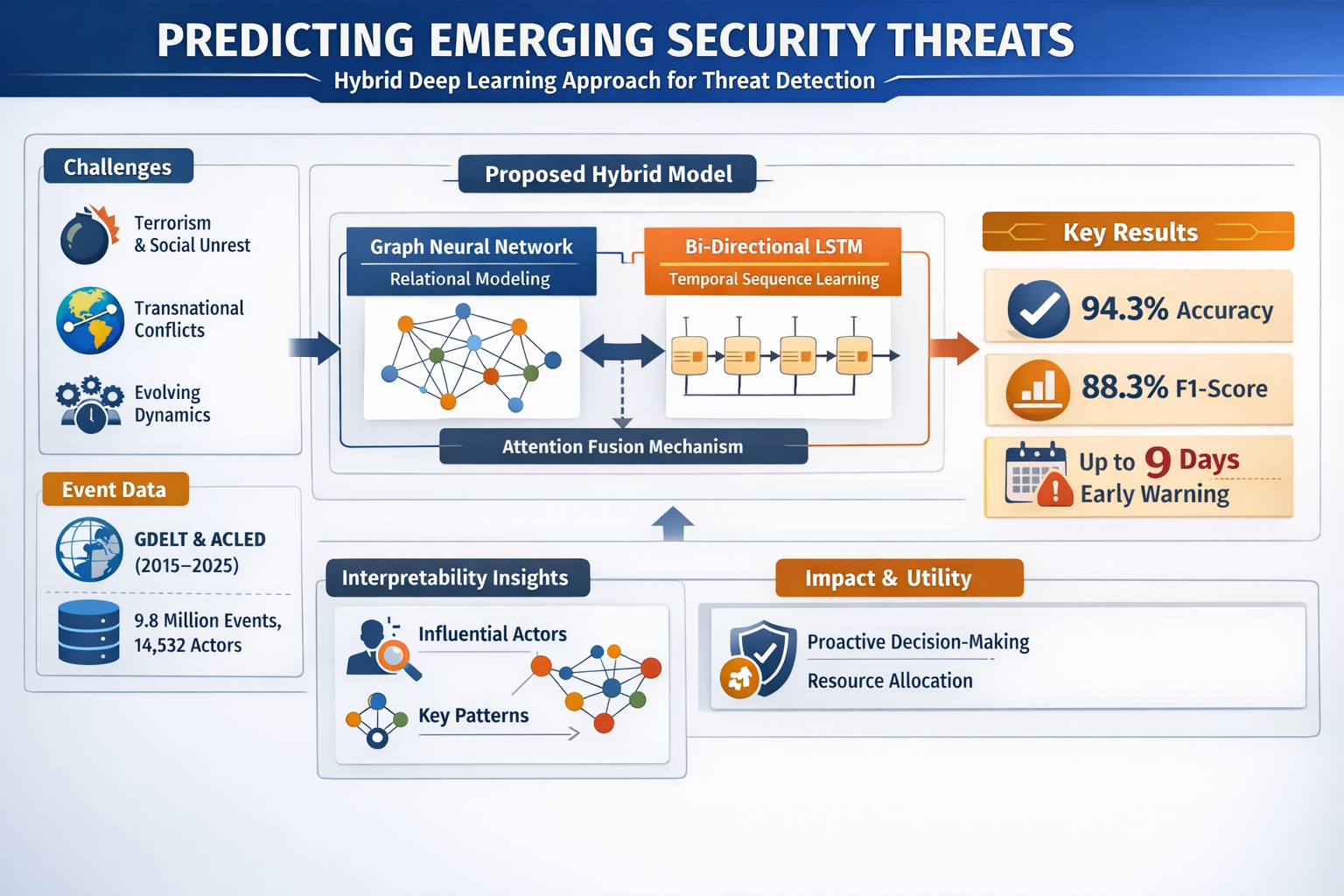
The increasing complexity and interconnectedness of modern security threats, including terrorism, social unrest, and transnational conflicts, pose significant challenges for traditional intelligence and threat detection systems, which struggle to capture both relational and temporal dynamics of evolving security environments. This study aims to develop a predictive framework capable of providing early warnings of emerging security threats by integrating graph-based relational modeling with temporal sequence learning. We propose a hybrid architecture combining Graph Neural Networks (GNN) with bidirectional Long Short-Term Memory (LSTM) networks, enhanced with an attention-based fusion mechanism to jointly model actor interactions and temporal evolution. The framework leverages large-scale event data from GDELT and ACLED spanning 2015–2025, encompassing over 9.8 million events and 14,532 unique actors, and constructs dynamic, attributed security networks to capture multi-dimensional actor relationships. Experimental results demonstrate that the proposed GNN-LSTM model achieves an overall accuracy of 94.3% and an F1-score of 88.3% for critical threat detection, outperforming traditional machine learning baselines and providing early warnings up to nine days in advance. The model also offers interpretability by highlighting influential actors and key relational patterns contributing to threat escalation. These findings suggest that integrating relational and temporal information through hybrid deep learning architectures significantly enhances predictive accuracy and operational utility in security threat assessment, offering a practical tool for proactive decision-making and resource allocation in complex security environments.
References
Blair, R. A., & Sambanis, N. (2020). Forecasting civil wars: Theory and structure in an age of big data and machine learning. Journal of Conflict Resolution, 64(10), 1885–1915. https://doi.org/10.1177/0022002720918923
Brandt, P. T., Freeman, J. R., & Schrodt, P. A. (2021). Evaluating forecasts of political conflict dynamics. International Journal of Forecasting, 30(4), 944–962. https://doi.org/10.1016/j.ijforecast.2014.03.014
Cederman, L.-E., & Gleditsch, K. S. (2020). Introduction to special issue on disaggregating civil war. Journal of Conflict Resolution, 53(4), 487–495. https://doi.org/10.1177/0022002709336454
Chadefaux, T. (2021). Early warning signals for war in the news. Journal of Peace Research, 51(1), 5–18. https://doi.org/10.1177/0022343313507302
Gleditsch, K. S., & Ward, M. D. (2021). Forecasting is difficult, especially about the future: Using contentious issues to forecast interstate disputes. Journal of Peace Research, 50(1), 17–31. https://doi.org/10.1177/0022343312449033
Goldstone, J. A., Bates, R. H., Epstein, D. L., Gurr, T. R., Lustik, M. B., Marshall, M. G., Ulfelder, J., & Woodward, M. (2020). A global model for forecasting political instability. American Journal of Political Science, 54(1), 190–208. https://doi.org/10.1111/j.1540-5907.2009.00426.x
Hamilton, W. L., Ying, R., & Leskovec, J. (2020). Inductive representation learning on large graphs. Advances in Neural Information Processing Systems, 30, 1024–1034. https://doi.org/10.5555/3294771.3294869
Hegghammer, T. (2020). The future of terrorism research. Perspectives on Terrorism, 14(6), 1–10. https://doi.org/10.2307/26940037
Hegre, H., Karlsen, J., Nygård, H. M., Strand, H., & Urdal, H. (2020). Predicting armed conflict, 2010--2050. International Studies Quarterly, 57(2), 250–270. https://doi.org/10.1111/isqu.12007
Hochreiter, S., & Schmidhuber, J. (2020). Long short-term memory. Neural Computation, 9(8), 1735–1780. https://doi.org/10.1162/neco.1997.9.8.1735
Kipf, T. N., & Welling, M. (2020). Semi-supervised classification with graph convolutional networks. International Conference on Learning Representations.
Metternich, N. W., Dorff, C., Gallop, M., Weschle, S., & Ward, M. D. (2021). Antigovernment networks in civil conflicts: How network structures affect conflictual behavior. American Journal of Political Science, 57(4), 892–911. https://doi.org/10.1111/ajps.12039
Muchlinski, D., Siroky, D., He, J., & Kocher, M. (2021). Comparing random forest with logistic regression for predicting class-imbalanced civil war onset data. Political Analysis, 24(1), 87–103. https://doi.org/10.1093/pan/mpv024
Mueller, H., & Rauh, C. (2020). Reading between the lines: Prediction of political violence using newspaper text. American Political Science Review, 114(2), 487–506. https://doi.org/10.1017/S0003055419000637
Raleigh, C., Linke, A., Hegre, H., & Karlsen, J. (2020). Introducing ACLED: An armed conflict location and event dataset. Journal of Peace Research, 47(5), 651–660. https://doi.org/10.1177/0022343310378914
Schrodt, P. A., & Yilmaz, cSevket. (2020). Conflict and Mediation Event Observations (CAMEO): An event data framework for a post Cold War world. International Interactions, 33(4), 423–443. https://doi.org/10.1080/03050620701552179
Sherstinsky, A. (2020). Fundamentals of recurrent neural network (RNN) and long short-term memory (LSTM) network. Physica D: Nonlinear Phenomena, 404, 132306. https://doi.org/10.1016/j.physd.2019.132306
Vaswani, A., Shazeer, N., Parmar, N., Uszkoreit, J., Jones, L., Gomez, A. N., Kaiser, Ł., & Polosukhin, I. (2020). Attention is all you need. Advances in Neural Information Processing Systems, 30.
Velickovic, P., Cucurull, G., Casanova, A., Romero, A., Liò, P., & Bengio, Y. (2020). Graph attention networks. ArXiv Preprint ArXiv:1710.10903. https://doi.org/10.48550/arXiv.1710.10903
Ward, M. D., Greenhill, B. D., & Bakke, K. M. (2020). The perils of policy by p-value: Predicting civil conflicts. Journal of Peace Research, 47(4), 363–375. https://doi.org/10.1177/0022343310364580
Weidmann, N. B., & Arjona, A. (2020). Agency, evolution, and social conflict. Rationality and Society, 32(3), 245–274. https://doi.org/10.1177/1043463120937640
Wu, Z., Pan, S., Chen, F., Long, G., Zhang, C., & Philip, S. Y. (2021). A comprehensive survey on graph neural networks. IEEE Transactions on Neural Networks and Learning Systems, 32(1), 4–24.
Zhou, J., Cui, G., Hu, S., Zhang, Z., Yang, C., Liu, Z., Wang, L., Li, C., & Sun, M. (2020). Graph neural networks: A review of methods and applications. AI Open, 1, 57–81. https://doi.org/10.1016/j.aiopen.2021.01.001