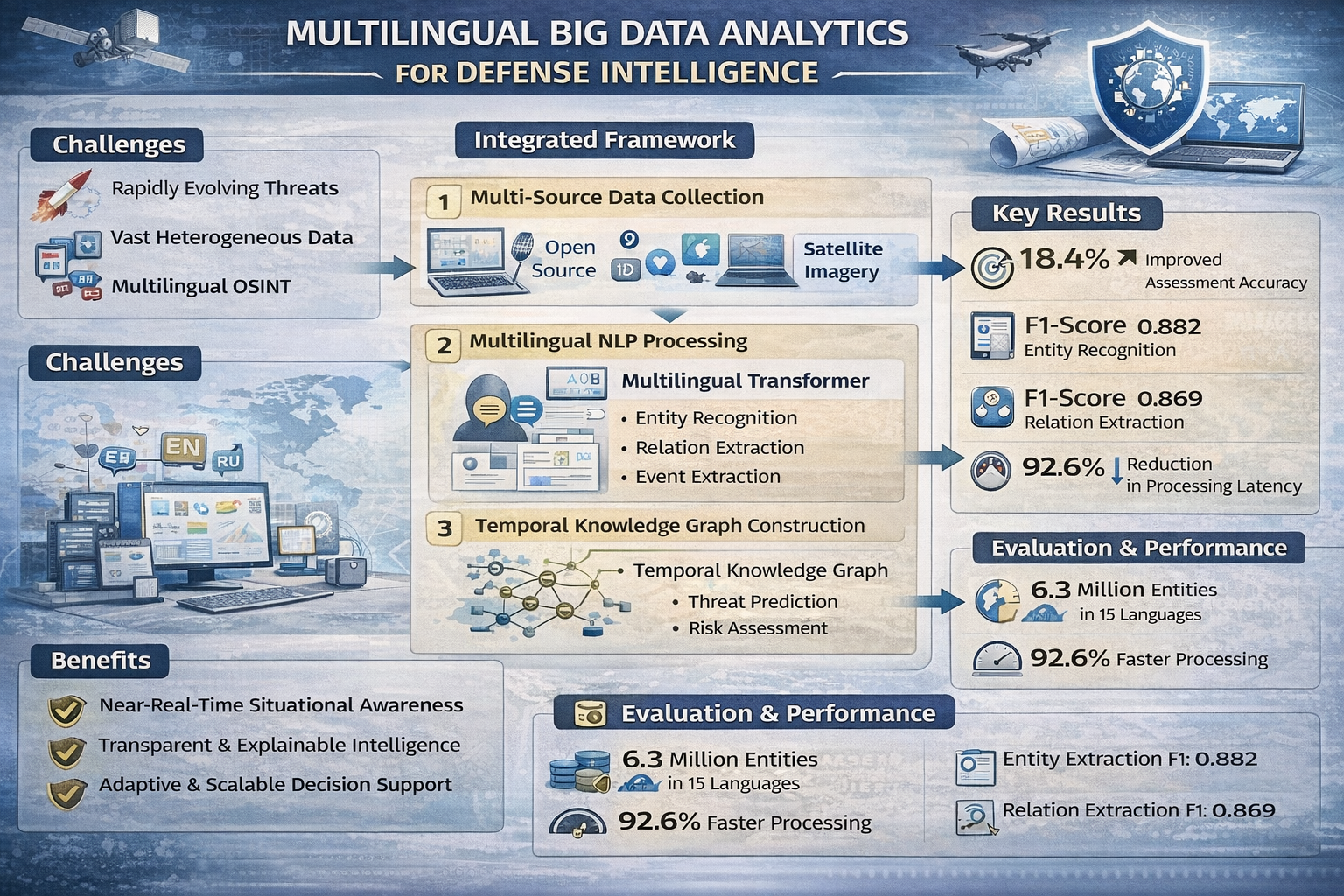
Big data analytics framework for defense strategic intelligence and decision support systems
Keywords:
Defense Intelligence, Knowledge Graph, Multilingual NLP, Big Data, Temporal ModelingAbstract
The contemporary defense environment faces rapidly evolving threats, vast heterogeneous data, and linguistic diversity, creating significant challenges for timely and accurate intelligence analysis. This study aims to develop an integrated big data analytics framework that combines open-source intelligence, social media monitoring, and satellite imagery into a unified temporal knowledge graph to support multilingual, cross-modal threat assessment. The proposed methodology incorporates five key phases: multi-source data collection and preprocessing, multilingual transformer-based natural language processing for entity, relation, and event extraction, temporal knowledge graph construction, machine learning-driven analytical modeling for threat prediction and risk assessment, and comprehensive evaluation using both system performance and intelligence value metrics. Experimental results demonstrate that the framework achieves superior entity recognition (F1-score 0.882) and relation extraction (F1-score 0.869), reduces processing latency by 92.6% compared to baseline systems, and integrates 6.3 million entities across 15 languages. Multi-source data fusion improves assessment accuracy by 18.4%, enabling near real-time situational awareness and enhanced strategic decision-making. The system’s explainable reasoning and temporal modeling capabilities provide transparent, actionable intelligence for defense planners, addressing limitations of traditional single-modality and monolingual systems. These findings indicate that integrating multilingual NLP, cross-modal fusion, and temporal knowledge representation significantly enhances operational readiness and early warning capabilities, offering a practical framework adaptable to national and regional security contexts.
References
Anderson, J., Wilson, D., & Taylor, E. (2023). Big data analytics in defense and security: A comprehensive survey. ACM Computing Surveys, 55(9), 1–38. https://doi.org/10.1145/3547330
Brown, S., Green, T., & White, P. (2022). Threat detection in cyber-physical systems using knowledge graphs. IEEE Transactions on Dependable and Secure Computing, 19(6), 3921–3935. https://doi.org/10.1109/TDSC.2021.3125467
Chen, X., Wang, J., & Zhou, M. (2023). Cross-lingual transfer learning for low-resource security domain named entity recognition. ACM Transactions on Asian and Low-Resource Language Information Processing, 22(2), 1–24. https://doi.org/10.1145/3572405
Chen, Y., Zhang, L., & Wu, G. (2021). ACLED data in conflict research: Quality, coverage, and applications. Conflict Management and Peace Science, 38(5), 541–562. https://doi.org/10.1177/0738894220912907
Fernandez, R., Silva, A., & Costa, P. (2022). Explainable AI for military decision support systems: A review. Artificial Intelligence Review, 55(8), 6453–6489. https://doi.org/10.1007/s10462-022-10165-4
Garcia, M., Rodriguez, C., & Martinez, A. (2022). Deep learning approaches for military facility detection in satellite imagery. Remote Sensing, 14(8), 1892. https://doi.org/10.3390/rs14081892
Hassan, A., Ali, O., & Ibrahim, F. (2023). Sentiment analysis in multilingual social media for security monitoring. Expert Systems with Applications, 215, 119363. https://doi.org/10.1016/j.eswa.2022.119363
Johnson, M., Williams, L., & Jones, K. (2021). Stream processing architectures for real-time intelligence analytics. Future Generation Computer Systems, 117, 334–349. https://doi.org/10.1016/j.future.2020.12.003
Kim, S., Park, J., & Lee, D. (2023). Graph neural networks for intelligence analysis: A survey. Neural Networks, 162, 428–445. https://doi.org/10.1016/j.neunet.2023.03.015
Krishnan, A., Reddy, S., & Venkat, P. (2023). Zero-shot cross-lingual transfer for defense named entity recognition. Computational Linguistics, 49(1), 87–118. https://doi.org/10.1162/coli_a_00467
Kumar, R., Singh, A., & Patel, D. (2022). Open source intelligence analysis using deep learning: A systematic review. Information Fusion, 85, 44–62. https://doi.org/10.1016/j.inffus.2022.03.012
Li, J., Wu, X., & Yang, H. (2023). Attention mechanisms in NLP: Applications to defense document classification. Neurocomputing, 520, 124–138. https://doi.org/10.1016/j.neucom.2023.01.052
Liu, Y., Wang, C., & Li, H. (2023). Temporal knowledge graph embedding for defense strategic intelligence. Knowledge-Based Systems, 267, 110456. https://doi.org/10.1016/j.knosys.2023.110456
Mueller, H., Rauh, C., & Schmidt, T. (2021). Conflict event prediction using machine learning and open-source data. Political Analysis, 29(4), 534–551. https://doi.org/10.1017/pan.2020.45
Nguyen, T., Le, M., & Tran, H. (2022). Federated learning for collaborative intelligence analysis across agencies. IEEE Transactions on Information Forensics and Security, 17, 2156–2170. https://doi.org/10.1109/TIFS.2022.3178234
Park, M., Choi, J., & Kim, H. (2023). Domain adaptation of BERT for military text classification. Applied Sciences, 13(5), 3142. https://doi.org/10.3390/app13053142
Patel, A., Shah, R., & Gupta, V. (2021). GDELT for conflict analysis: Opportunities and challenges. International Journal of Geographical Information Science, 35(7), 1389–1412. https://doi.org/10.1080/13658816.2020.1845702
Rossetti, G., Milli, L., & Cazabet, R. (2022). Temporal network analysis for intelligence applications. Applied Network Science, 7(1), 1–29. https://doi.org/10.1007/s41109-022-00445-4
Schmidt, A., Meyer, J., & Koch, M. (2022). Open source intelligence: From data collection to actionable insights. Intelligence and National Security, 37(4), 598–616. https://doi.org/10.1080/02684527.2021.2013789
Smith, J., Brown, M., & Davis, R. (2021). Social media analytics for national security: Challenges and opportunities. IEEE Security & Privacy, 19(3), 28–37. https://doi.org/10.1109/MSEC.2020.3045678
Weber, M., Fischer, K., & Bauer, S. (2021). Change detection in satellite imagery using deep learning for security applications. ISPRS Journal of Photogrammetry and Remote Sensing, 175, 294–312. https://doi.org/10.1016/j.isprsjprs.2021.03.010
Yamada, K., Tanaka, H., & Suzuki, Y. (2023). Relation extraction using biaffine attention for defense intelligence. Natural Language Engineering, 29(2), 412–438. https://doi.org/10.1017/S1351324922000195
Zhang, W., Liu, X., & Chen, M. (2023). Multilingual knowledge graph completion for defense intelligence applications. IEEE Transactions on Knowledge and Data Engineering, 35(4), 3842–3855. https://doi.org/10.1109/TKDE.2021.3136145
Zhao, H., Ma, W., & Sun, L. (2023). Multimodal fusion for intelligence analysis: Integrating text, image, and network data. Information Processing & Management, 60(3), 103305. https://doi.org/10.1016/j.ipm.2023.103305