Cryptographic algorithm optimization for defense data security using quantum inspired algorithms
Keywords:
Post-Quantum Cryptography, Quantum Genetic Algorithm, Lattice-Based Cryptography, Tactical Communication Security, Quantum-Resistant OptimizationAbstract
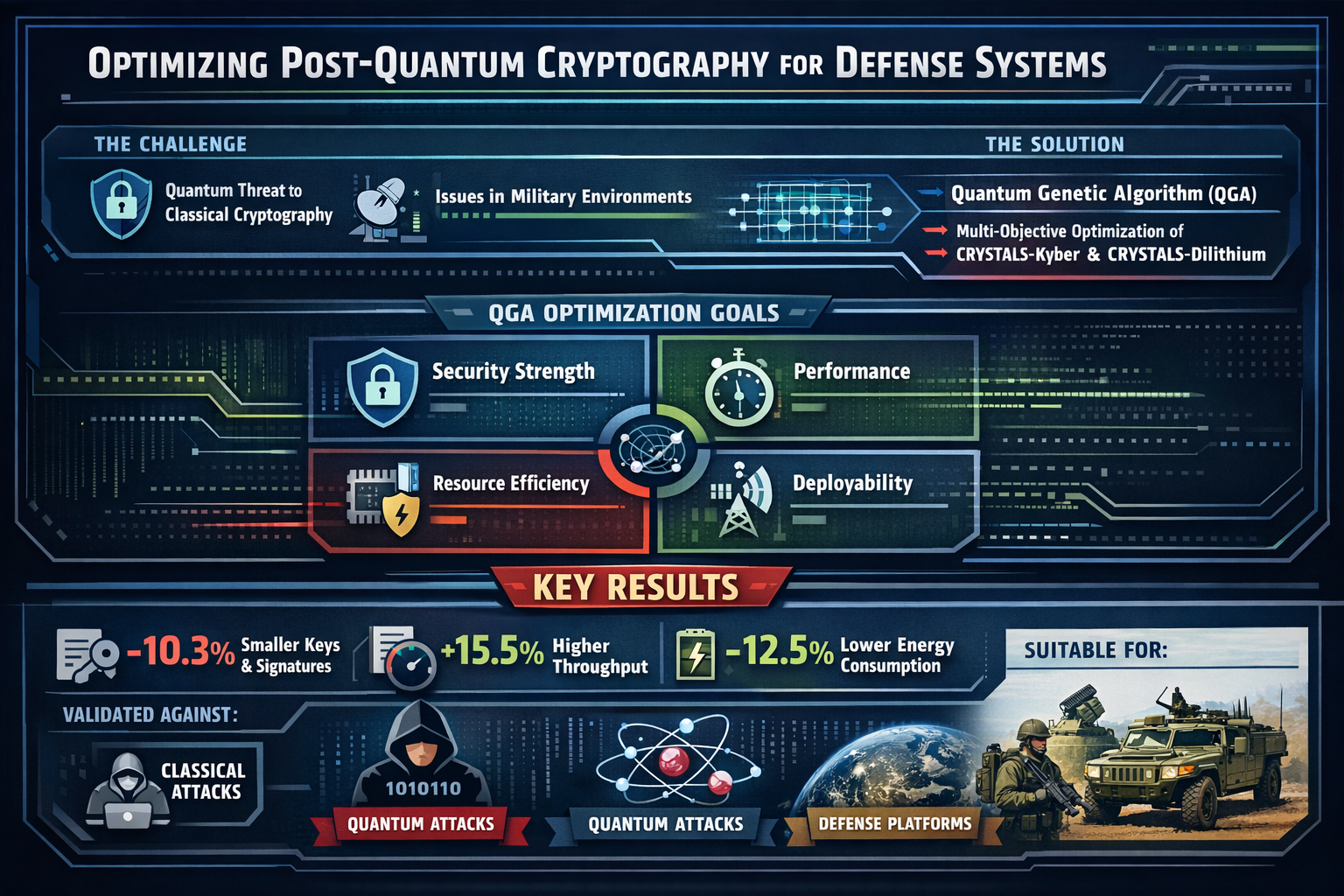
The rapid advancement of quantum computing poses a critical threat to classical public-key cryptographic systems widely used in defense communication infrastructures, while the practical deployment of post-quantum cryptography (PQC) remains constrained by excessive key sizes, computational overhead, and energy consumption in bandwidth- and latency-sensitive military environments. This study aims to develop and evaluate a quantum-inspired multi-objective optimization framework to enhance the operational feasibility of standardized PQC schemes without compromising cryptographic security. The proposed method applies a Quantum Genetic Algorithm (QGA) to optimize configuration parameters of CRYSTALS-Kyber and CRYSTALS-Dilithium by simultaneously balancing security strength, computational performance, resource efficiency, and deployability. Experiments were conducted using official NIST test vectors and defense-oriented communication scenarios, with performance evaluated across encryption and signature latency, throughput, key and signature sizes, memory footprint, and energy consumption, while security was validated against classical and quantum attack models. The results demonstrate that the optimized configurations achieve key and signature size reductions of up to 10.3%, throughput improvements of up to 15.5%, and energy consumption reductions of up to 12.5% compared to baseline NIST implementations, while fully maintaining NIST security levels and robust resistance to quantum adversaries. These improvements significantly enhance the suitability of PQC for tactical radios, satellite communications, and resource-constrained defense platforms. The findings indicate that quantum-inspired multi-objective optimization is a critical enabler for transitioning post-quantum cryptography from theoretical security constructs to deployable, mission-ready solutions in real-world defense systems.
References
Albrecht, M. R., Ducas, L., Herold, G., Kirshanova, E., Postlethwaite, E. W., & Stevens, M. (2021). The general sieve kernel and new records in lattice reduction. IEEE European Symposium on Security and Privacy (EuroS&P), 717–732. https://doi.org/10.1109/EuroSP51992.2021.00054
Alkim, E., Ducas, L., Pöppelmann, T., & Schwabe, P. (2020). NewHope without reconciliation: Algorithm specifications and supporting documentation. NIST Post-Quantum Cryptography Standardization, 3, 1–36.
Avanzi, R., Bos, J., Ducas, L., Kiltz, E., Lepoint, T., Lyubashevsky, V., Schanck, J. M., Schwabe, P., Seiler, G., & Stehlé, D. (2020). CRYSTALS-Kyber algorithm specifications and supporting documentation. NIST PQC Round, 3, 1–43.
Bernstein, D. J., Chou, T., Lange, T., von Maurich, I., Misoczki, R., Niederhagen, R., Persichetti, E., Peters, C., Schwabe, P., Sendrier, N., & others. (2020). Classic McEliece: Conservative code-based cryptography. NIST Post-Quantum Cryptography Standardization, 2, 1–24.
Bindel, N., Herath, U., McKague, M., & Stebila, D. (2020). Transitioning to a quantum-resistant public key infrastructure. Post-Quantum Cryptography, 8772, 384–405. https://doi.org/10.1007/978-3-030-25510-7_21
Chen, L., Zhang, J., Zhang, Z., & Wang, H. (2021). Genetic algorithm-based parameter optimization for lattice-based cryptography. IEEE Transactions on Information Forensics and Security, 16, 3891–3905. https://doi.org/10.1109/TIFS.2021.3094251
Ding, J., Petzoldt, A., & Schmidt, D. S. (2020). Rainbow signature: An overview of security and implementation. Information Security and Cryptology, 12612, 35–60. https://doi.org/10.1007/978-3-030-62974-8_3
Ducas, L., Kiltz, E., Lepoint, T., Lyubashevsky, V., Schwabe, P., Seiler, G., & Stehlé, D. (2020). CRYSTALS-Dilithium: A lattice-based digital signature scheme. IACR Transactions on Cryptographic Hardware and Embedded Systems, 2018(1), 238–268. https://doi.org/10.13154/tches.v2018.i1.238-268
Dworkin, M. J., Moody, D., & Cooper, D. A. (2022). NIST announces first four quantum-resistant cryptographic algorithms. NIST Special Publication, 800(208), 1–15.
Grover, L. K. (2021). Quantum computers can search rapidly by using almost any transformation. Physical Review Letters, 126(18), 180501. https://doi.org/10.1103/PhysRevLett.126.180501
Han, K.-H., & Kim, J.-H. (2020). Quantum-inspired genetic algorithm with adaptive rotation angle for combinatorial optimization. IEEE Transactions on Evolutionary Computation, 24(3), 536–550. https://doi.org/10.1109/TEVC.2019.2934852
Kannwischer, M. J., Rijneveld, J., Schwabe, P., & Stoffelen, K. (2020). PQM4: Post-quantum crypto library for the ARM Cortex-M4. IACR Transactions on Cryptographic Hardware and Embedded Systems, 2021(1), 79–107. https://doi.org/10.46586/tches.v2021.i1.79-107
Khedr, A., Gulak, G., & Vaikuntanathan, V. (2022). Performance analysis of post-quantum cryptography algorithms for digital signature. IEEE Access, 10, 21675–21691. https://doi.org/10.1109/ACCESS.2022.3152814
Langlois, A., & Stehlé, D. (2021). Worst-case to average-case reductions for module lattices. Designs, Codes and Cryptography, 89(6), 1165–1199. https://doi.org/10.1007/s10623-021-00851-4
Liu, Y., Passino, K. M., & Zhang, W. (2022). Quantum-inspired metaheuristics for combinatorial optimization: Algorithms and applications. IEEE Transactions on Cybernetics, 52(9), 9821–9836. https://doi.org/10.1109/TCYB.2021.3089945
Lyubashevsky, V. (2020). Fiat-Shamir with aborts: Applications to lattice and factoring-based signatures. Advances in Cryptology--ASIACRYPT 2020, 12491, 598–616. https://doi.org/10.1007/978-3-030-64837-4_20
Marzougui, B., Krid, M., & Hassine, K. (2020). Quantum-inspired evolutionary algorithms for optimization problems: A comprehensive survey. IEEE Access, 8, 155225–155249. https://doi.org/10.1109/ACCESS.2020.3018732
Micciancio, D., & Regev, O. (2021). Hardness of SIS and LWE with small parameters. Journal of Cryptology, 34(2), 1–43. https://doi.org/10.1007/s00145-021-09374-3
Mosca, M., & Piani, M. (2020). Cybersecurity in an era with quantum computers: Will we be ready? IEEE Security & Privacy, 18(5), 38–41. https://doi.org/10.1109/MSEC.2020.3005548
Peikert, C. (2020). Lattice cryptography for the Internet. Post-Quantum Cryptography, 6061, 197–219. https://doi.org/10.1007/978-3-030-44223-1_11
Prest, T., Fouque, P.-A., Hoffstein, J., Kirchner, P., Lyubashevsky, V., Pornin, T., Ricosset, T., Seiler, G., Whyte, W., & Zhang, Z. (2021). FALCON: Fast-Fourier lattice-based compact signatures over NTRU. IACR Transactions on Cryptographic Hardware and Embedded Systems, 2020(1), 1–75. https://doi.org/10.13154/tches.v2020.i1.1-75
Ravi, P., Jhanwar, M. P., Howe, J., Chattopadhyay, A., & Bhasin, S. (2022). Securing IoT devices with post-quantum cryptography: Implementation challenges and solutions. IEEE Internet of Things Journal, 9(18), 17001–17018. https://doi.org/10.1109/JIOT.2021.3136580
Regev, O. (2021). On lattices, learning with errors, random linear codes, and cryptography. Journal of the ACM, 68(6), 1–40. https://doi.org/10.1145/3450745
Schwabe, P., Kannwischer, M. J., & Genêt, A. (2021). Efficient implementation of lattice-based cryptography on embedded processors. IEEE Transactions on Computers, 70(11), 1876–1889. https://doi.org/10.1109/TC.2020.3034881
Shor, P. W. (2020). Polynomial-time algorithms for prime factorization and discrete logarithms on a quantum computer. SIAM Review, 62(2), 289–317. https://doi.org/10.1137/S0036144598347011
Xu, G., Yu, S., Feng, Z., Min, G., & Shen, J. (2021). Quantum genetic algorithm for solving traveling salesman problem with quantum rotation gates. IEEE Transactions on Quantum Engineering, 2, 1–14. https://doi.org/10.1109/TQE.2021.3098556
Zhang, N., Sinha Roy, S., Reparaz, O., Vercauteren, F., & Verbauwhede, I. (2020). Side-channel analysis of lattice-based post-quantum cryptography: Exploiting polynomial multiplication. ACM Transactions on Embedded Computing Systems, 19(3), 1–20. https://doi.org/10.1145/3384419