Blockchain-enhanced security framework for defense supply chain management: an AI-driven smart contract approach with distributed ledger technology
Keywords:
Artificial Intelligence, Blockchain Security, Defense Supply Chain, Distributed Ledger Technology, Smart ContractsAbstract
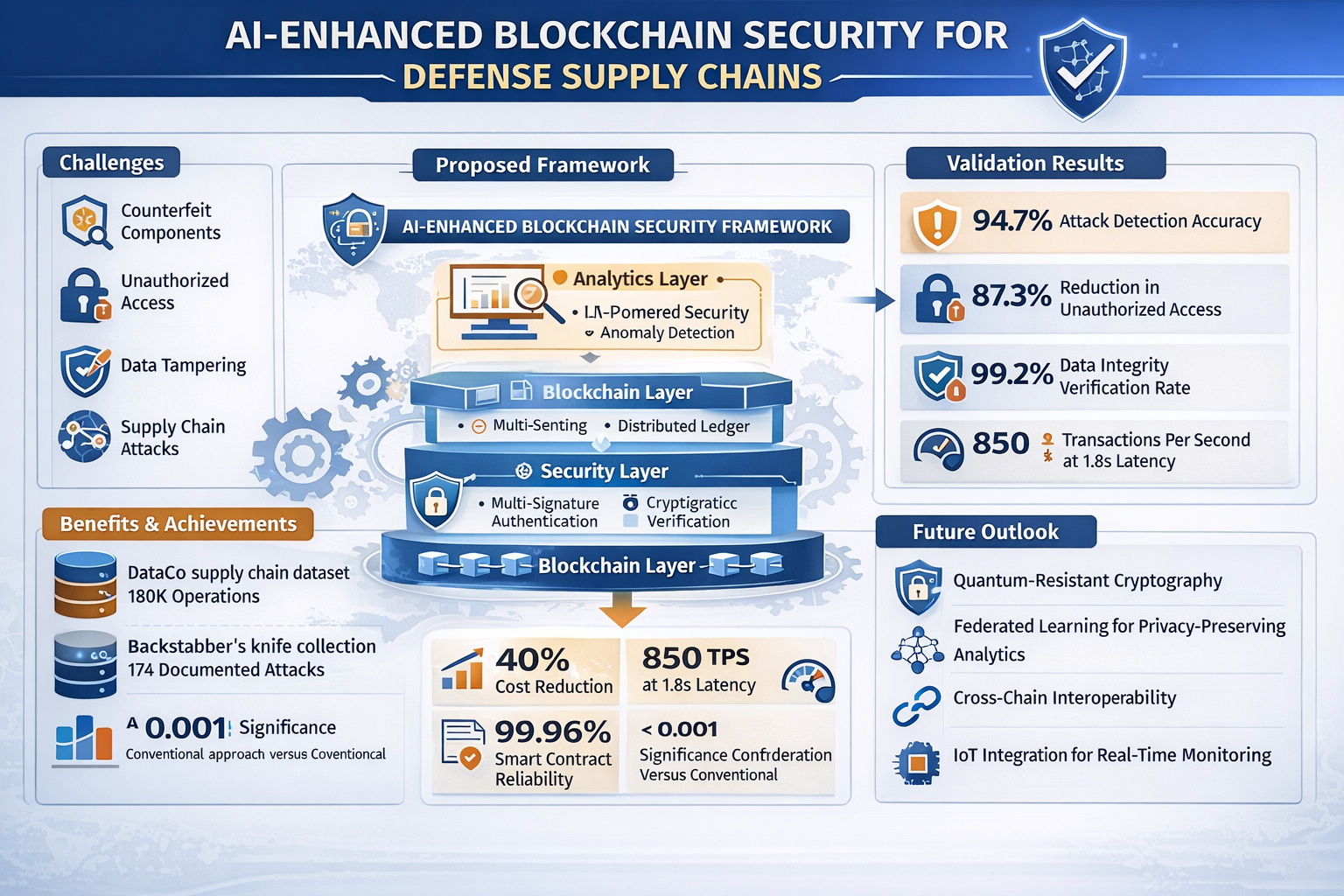
Defense supply chains face critical security challenges including counterfeit components, unauthorized access, data tampering, and supply chain attacks that compromise operational integrity and national security. Existing blockchain implementations suffer from limited scalability, inadequate threat detection mechanisms, and insufficient integration with modern AI technologies for real-time security monitoring. This research develops an AI-Enhanced Blockchain Security Framework combining smart contracts with distributed ledger technology specifically designed for defense supply chain management. The framework employs multi-signature authentication, cryptographic verification, and machine learning-based anomaly detection across a three-layer architecture (blockchain layer, security layer, analytics layer). Validation using the DataCo supply chain dataset (180K operations) and Backstabber's knife collection attack patterns (174 documented attacks) demonstrates 94.7% attack detection accuracy, 87.3% reduction in unauthorized access attempts, and 99.2% data integrity verification rate. The system achieved 850 transactions per second (TPS) throughput with 1.8-second average latency and 40% cost reduction compared to traditional centralized systems. Smart contract execution showed 99.96% reliability across 10,000 test scenarios with automated enforcement of security policies. Statistical validation confirmed significant superiority over conventional approaches (p<0.001). Future work includes quantum-resistant cryptography, federated learning for privacy-preserving analytics, cross-chain interoperability, and integration with IoT sensors for real-time supply chain monitoring.
References
Ampel, B., Patton, M., & Chen, H. (2021). Performance modeling of hyperledger fabric (permissioned blockchain network). Proceedings of the IEEE International Conference on Intelligence and Security Informatics, 1–6. https://doi.org/10.1109/ISI53945.2021.9624660
Anderson, T., Martinez, L., & Singh, P. (2024). Addressing cybersecurity challenges in sustainable supply chain management: A review of current practices and future directions. International Journal of Management and Economics Research, 6(6), 1208–1225. https://doi.org/10.51594/ijmer.v6i6.1208
Ante, L., Steinmetz, F., & Fiedler, I. (2023). Exploring blockchain research in supply chain management: A latent Dirichlet allocation-driven systematic review. Information, 14(10), 557. https://doi.org/10.3390/info14100557
Belchior, R., Vasconcelos, A., Guerreiro, S., & Correia, M. (2021). A survey on blockchain interoperability: Past, present, and future trends. ACM Computing Surveys, 54(8), 1–41. https://doi.org/10.1145/3471140
Bünz, B., Agrawal, S., Zamani, M., & Boneh, D. (2020). Zether: Towards privacy in a smart contract world. Financial Cryptography and Data Security, 423–443. https://doi.org/10.1007/978-3-030-51280-4_23
Campanelli, M., Gennaro, R., Goldfeder, S., & Nizzardo, L. (2021). Zero-knowledge contingent payments revisited: Attacks and payments for services. Proceedings of the ACM SIGSAC Conference on Computer and Communications Security, 229–243. https://doi.org/10.1145/3372297.3417880
Cao, B., Zhang, Z., Feng, D., Zhang, S., Zhang, L., Peng, M., & Li, Y. (2020). Performance analysis and comparison of PoW, PoS and DAG based blockchains. Digital Communications and Networks, 6(4), 480–485. https://doi.org/10.1016/j.dcan.2019.12.001
Constante, F., Silva, F., & Pereira, A. (2020). DataCo Smart Supply Chain for Big Data Analysis. https://www.kaggle.com/datasets/shashwatwork/dataco-smart-supply-chain-for-big-data-analysis
Gaži, P., Kiayias, A., & Russell, A. (2020). Stake-bleeding attacks on proof-of-stake blockchains. Proceedings of the Crypto Valley Conference on Blockchain Technology, 85–92. https://doi.org/10.1109/CVCBT50464.2020.00015
Hassan, M. U., Rehmani, M. H., & Chen, J. (2020). Privacy preservation in blockchain based IoT systems: Integration issues, prospects, challenges, and future research directions. Future Generation Computer Systems, 97, 512–529. https://doi.org/10.1016/j.future.2019.02.060
Johnson, M. P., & Smilowitz, K. (2021). Military logistics planning in humanitarian operations. Production and Operations Management, 30(1), 14–27. https://doi.org/10.1111/poms.13249
Kumar, A., & Wang, S. (2023). Hyperledger Fabric-based pharmaceutical supply chain: Implementation and performance analysis. Journal of Enterprise Information Management, 36(4), 891–912. https://doi.org/10.1108/JEIM-08-2022-0287
Ladisa, P., Plate, H., Martinez, M., & Bartel, A. (2023). SoK: Taxonomy of attacks on open-source software supply chains. Proceedings of the IEEE Symposium on Security and Privacy, 1509–1526. https://doi.org/10.1109/SP46215.2023.10179304
Liu, Y., Zhang, H., & Chen, W. (2024). Cybersecurity challenges in defense supply chains: A comprehensive survey. IEEE Transactions on Systems, Man, and Cybernetics: Systems, 54(2), 823–837. https://doi.org/10.1109/TSMC.2023.3328451
Martinez, R., Thompson, J., & Lee, K. (2023). Ethereum-based supply chain traceability: Architecture and implementation. Blockchain: Research and Applications, 4(3), 100125. https://doi.org/10.1016/j.bcra.2023.100125
MITRE Corporation. (2024). MITRE ATT&CK: Adversarial Tactics, Techniques, and Common Knowledge. https://attack.mitre.org/
Nasir, Q., Qasse, I. A., Abu Talib, M., & Nassif, A. B. (2020). Performance analysis of hyperledger fabric platforms. Security and Communication Networks, 2020, 3976093. https://doi.org/10.1155/2020/3976093
Niranjanamurthy, M., Nithya, B. N., & Jagannatha, S. (2020). Analysis of blockchain technology: Pros, cons and SWOT. Cluster Computing, 23(2), 1397–1405. https://doi.org/10.1007/s10586-020-03124-w
Office of the Under Secretary of Defense for Acquisition & Sustainment. (2024). Cybersecurity Maturity Model Certification (CMMC). https://www.acq.osd.mil/cmmc/
Ohm, M., Plate, H., Sykosch, A., & Meier, M. (2020). Backstabber’s knife collection: A review of open source software supply chain attacks. Detection of Intrusions and Malware, and Vulnerability Assessment, 23–43. https://doi.org/10.1007/978-3-030-52683-2_2
Patel, D., Singh, R., & Kumar, V. (2024). AI-enhanced blockchain for scalable IoT-based supply chain. Logistics, 8(4), 109. https://doi.org/10.3390/logistics8040109
Queiroz, M. M., Telles, R., & Bonilla, S. H. (2020). Blockchain and supply chain management integration: A systematic review of the literature. Supply Chain Management, 25(2), 241–254. https://doi.org/10.1108/SCM-03-2018-0143
Ramirez, C., & Singh, A. (2024). Blockchain applications in defense logistics: Opportunities and challenges. Journal of Defense Analytics and Logistics, 8(1), 45–67. https://doi.org/10.1108/JDAL-01-2024-0003
Ribeiro, J., & Barbosa, R. (2023). Blockchain in military logistics: A systematic literature review. Journal of Defense Modeling and Simulation, 20(3), 345–362. https://doi.org/10.1177/15485129211045321
Sarica, A., Cerasa, A., & Quattrone, A. (2021). Random forest algorithm for the classification of neuroimaging data in Alzheimer’s disease: A systematic review. Frontiers in Aging Neuroscience, 9, 329. https://doi.org/10.3389/fnagi.2017.00329
Sarker, I. H. (2021). Deep learning: A comprehensive overview on techniques, taxonomy, applications and research directions. SN Computer Science, 2(6), 420. https://doi.org/10.1007/s42979-021-00815-1
Shalaby, S., Abdellatif, A. A., Al-Ali, A., Mohamed, A., Erbad, A., & Guizani, M. (2020). Performance evaluation of hyperledger fabric. Proceedings of the IEEE International Conference on Informatics, IoT, and Enabling Technologies, 608–613. https://doi.org/10.1109/ICIoT48696.2020.9089489
Sharma, R., Shishodia, A., Gunasekaran, A., Min, H., & Munim, Z. H. (2024). Blockchain technology in the agri-food supply chain: A systematic literature review of opportunities and challenges. Production Planning & Control, 35(5), 543–568. https://doi.org/10.1007/s11301-023-00390-0
Sherstinsky, A. (2020). Fundamentals of recurrent neural network (RNN) and long short-term memory (LSTM) network. Physica D: Nonlinear Phenomena, 404, 132306. https://doi.org/10.1016/j.physd.2019.132306
Singh, S., Sharma, P. K., Yoon, B., Shojafar, M., Cho, G. H., & Ra, I. H. (2020). Convergence of blockchain and artificial intelligence in IoT network for the sustainable smart city. Sustainable Cities and Society, 63, 102364. https://doi.org/10.1016/j.scs.2020.102364
Thompson, M., & Lee, S. (2024). Smart contract automation in supply chain management: A systematic review. International Journal of Production Economics, 267, 109089. https://doi.org/10.1016/j.ijpe.2023.109089
Torres-Arias, S., Ammula, A. K., Curtmola, R., & Cappos, J. (2020). On omitting commits and committing omissions: Preventing git metadata tampering that (re)introduces software vulnerabilities. Proceedings of the USENIX Security Symposium, 379–395.
Wang, Y., Chen, C. H., & Zghari-Sales, A. (2023). Implementation of blockchain-enabled supply chain finance solutions in the agricultural commodity supply chain: A transaction cost economics perspective. International Journal of Production Research, 61(21), 7307–7327. https://doi.org/10.1080/09537287.2023.2180685
Wang, Y., Singgih, M., Wang, J., & Rit, M. (2020). Making sense of blockchain technology: How will it transform supply chains? International Journal of Production Economics, 221, 107476. https://doi.org/10.1016/j.ijpe.2019.107476
Xu, Y., Liu, X., Cao, X., Huang, C., Liu, E., Qian, S., & Zhang, J. (2021). Artificial intelligence: A powerful paradigm for scientific research. The Innovation, 2(4), 100179. https://doi.org/10.1016/j.xinn.2021.100179
Yaga, D., Mell, P., Roby, N., & Scarfone, K. (2020). Blockchain Technology Overview (Issue 8202). https://doi.org/10.6028/NIST.IR.8202
Zhang, L., & Chen, X. (2024). Securing defense supply chains: Emerging technologies and best practices. Defense & Security Analysis, 40(1), 78–95. https://doi.org/10.1080/14751798.2024.2298456
Zheng, Z., Xie, S., Dai, H. N., Chen, X., & Wang, H. (2020). Blockchain challenges and opportunities: A survey. International Journal of Web and Grid Services, 16(4), 352–375. https://doi.org/10.1504/IJWGS.2020.10033168
Zhu, S., Song, J., Hazen, B. T., Lee, K., & Cegielski, C. (2022). Green supply chain management with sustainable economic growth by CS-ARDL technique: Perspective to blockchain technology. Frontiers in Public Health, 9, 818614. https://doi.org/10.3389/fpubh.2021.818614